Willem Warmbold
There's a moment every composite deck owner eventually has: it's a beautiful summer afternoon, you step outside to enjoy the deck you paid a premium for, and you can't stand on it. Not figuratively. Literally.
That's not an outlier experience. Independent field testing on composite decking surfaces has recorded temperatures over 150°F, running 35 to 76°F hotter than the surrounding air. A separate side-by-side comparison of decking materials found the same pattern holds across brands and colors, with composite consistently outpacing wood and other surfaces in direct sun. Darker composite boards, the espresso and charcoal tones that dominate the high-end lines right now, have measured as high as 190 to 200°F. For reference, dermatology research puts the burn threshold for skin contact at around 130°F. A composite deck in full sun isn't just uncomfortable. On the wrong afternoon, it's a hazard.
Black locust doesn't have this problem, because it isn't a plastic-and-resin product wearing a wood costume. It's real hardwood: dense, solid, and thermally behaving like the material it actually is rather than a polymer engineered to look like something else.
Composite is marketed on lifetime value: no staining, no sealing, install it and forget it. That pitch only holds if the material actually lasts as advertised and doesn't need early replacement. Black locust carries a Janka hardness of roughly 1,700 lbf, harder than most composite cores, and a documented service life of 25 to 100 years in ground contact, without any chemical treatment. It's naturally rot-resistant and rated Class 1 durability, the same category as tropical hardwoods like ipe, except it's sourced in North America instead of shipped across an ocean.
Composite's upfront cost is often comparable to or higher than black locust once you account for the premium capped lines from brands like Trex and TimberTech's AZEK. The difference is what happens after year one, which is where the next several points matter. Black locust also carries a 50-year structural warranty and a Class A fire rating (flame spread ≤25 under ASTM E84, the same classification as concrete and metal). Full specs are in our decking spec sheet.
Composite manufacturers have gotten good at embossing grain patterns into their boards. Good enough to fool a photo. Not good enough to fool a hand run across the surface, or an eye trained to notice repetition: most composite grain patterns are pulled from a limited set of molds and repeat visibly across a run of boards. On a spec-grade project where an architect or client is paying attention to material honesty, that repetition reads as exactly what it is: manufactured, not grown. Black locust has the grain, density, and weight of an actual tree, because it is one.
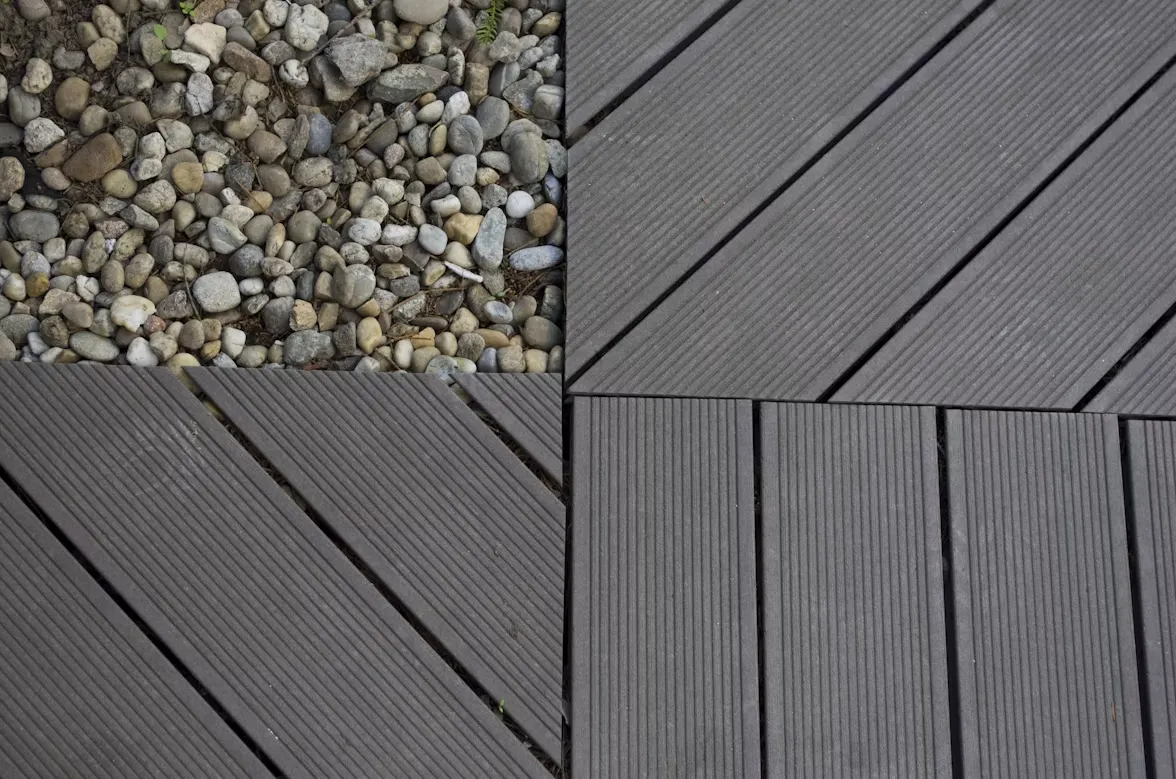
Composite's rot resistance is real. Its damage resistance is not. The plastic-resin surface scratches from grill castors, dragged furniture, and normal pet activity, and once it's scratched, there's no fixing it: you can't sand a composite board the way you sand wood. A gouge in a composite deck typically means pulling and replacing that board, not touching it up.
Fading is the second issue. UV inhibitors slow color loss, but they don't stop it, and fading is rarely uniform. Shaded sections next to sun-exposed sections age at different rates, so a composite deck a few years in often looks patchy rather than uniformly weathered.
Third is expansion and contraction, which is a direct consequence of the heat problem above. Composite moves more than wood across a temperature swing, which means installation gap spacing has to be adjusted for the temperature at install, as tight as 1/32" in 110°F heat, opening up to roughly 1/4" in 35°F cold. Get that spacing wrong and you get buckling or uneven gaps a year or two down the line. It's a material that requires more precision to install correctly than the "worry-free" marketing suggests.
Trex, TimberTech, and Fiberon are the three brands that dominate composite decking, and each has earned its position. Trex invented the category and still leads on recycled content and scratch resistance in its premium Transcend line. TimberTech's AZEK PVC line leads on moisture protection and offers the strongest warranties in the category. Fiberon competes hardest on price for homeowners trying to get composite performance without the top-tier cost.
All three are legitimate products for what they are. What they are is a manufactured composite of wood fiber, plastic, and bonding agents, engineered to resist rot, not to solve heat, damage, or long-term appearance. Black locust starts from a different premise: a naturally durable hardwood that doesn't need engineering to survive outdoors, because it already does.
Composite brands lean hard on recycled content. Trex and Fiberon both cite figures in the 94 to 96% range. That's a genuine sustainability effort, and it deserves credit. But recycled plastic and wood fiber bonded with adhesives is still a manufactured composite at end of life, and it's difficult to recycle a second time once it's been through that process. Black locust is a solid, naturally regenerating hardwood grown in North America, with no chemical treatment required to hit a multi-decade service life. If the goal is genuinely low-impact decking, the comparison isn't as close as the composite industry's messaging implies.
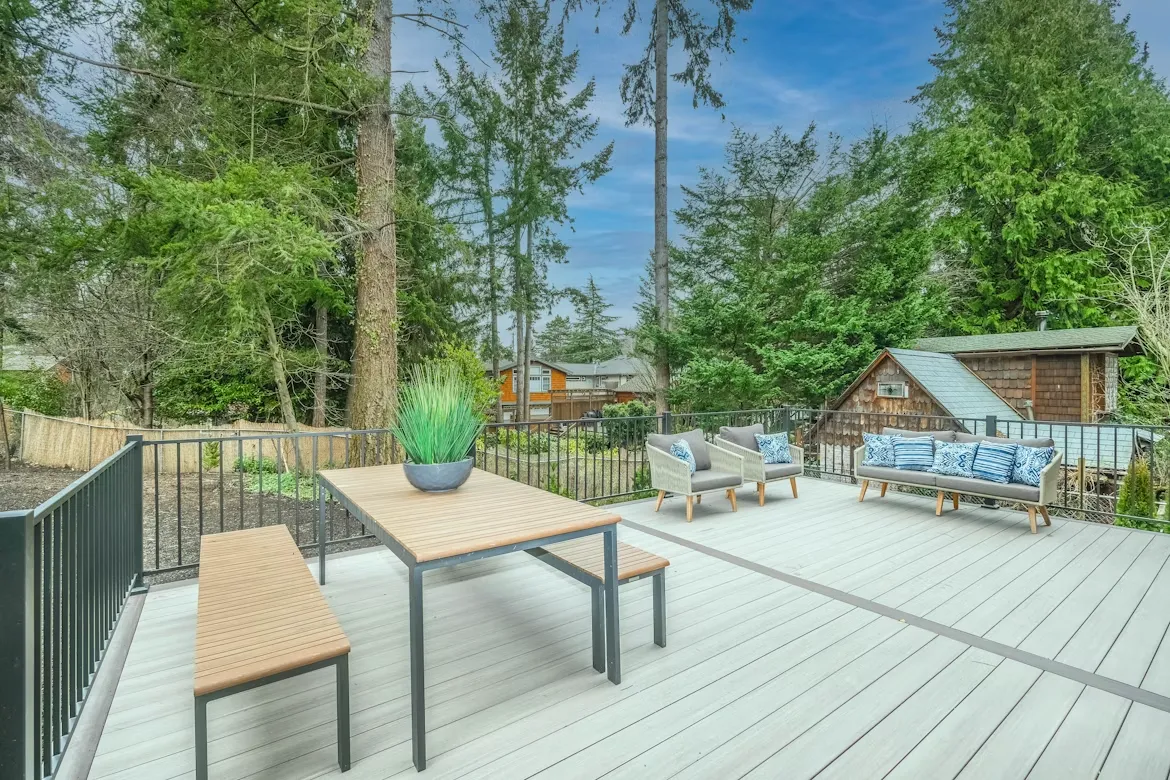
Composite decking was built to solve wood's real weaknesses: rot, staining, and annual maintenance. It solves those. But it introduces a new one that's arguably worse for the actual point of having a deck: you may not be able to comfortably use it during the exact season you built it for. Black locust solves the maintenance problem the way composite claims to, without the heat, the scratches, or the manufactured look.
Before you commit to a decking material, ask the question that's easy to skip in a showroom: will you actually want to walk out onto it barefoot on a July afternoon? For one of these materials, the honest answer is no.
Ready to compare specs side by side? Browse our black locust decking solutions or download the full decking spec sheet: sizes, profiles, hardware, warranty terms, and technical data in one PDF.
Is black locust decking more expensive than composite decking?
Upfront pricing is comparable, and often lower than premium capped composite lines. The real cost gap shows up over time: black locust needs no chemical treatment to hit a 25-100 year lifespan, while composite's lower maintenance cost can be offset by board replacement after scratches or impact damage that can't be repaired in place.
Is natural wood or composite decking better for hot climates?
Composite retains significantly more heat than natural wood. Surface temperatures on composite boards have been measured 35-76°F above ambient air temperature, with dark tones reaching 190-200°F in direct sun. Natural hardwoods like black locust don't have this heat-trapping behavior because they aren't a plastic-resin material.
What are the most common composite decking problems?
The recurring issues are heat retention, scratches and gouges that can't be sanded out, uneven fading from UV exposure, and expansion/contraction that requires precise gap spacing at installation. None of these are defects. They're inherent to building a deck surface out of plastic, wood fiber, and adhesive.
How does black locust compare to Trex decking?
Trex is the composite category leader and performs well for what it is. Black locust is a solid hardwood with a Janka hardness around 1,700 lbf, naturally rot-resistant without any treatment, and Class 1 durability rated. The tradeoff comes down to a manufactured product engineered to resist rot versus a natural material that already resists it.
Why does composite decking get so hot in the summer?
Composite is made from plastic resin and wood fiber, and plastic absorbs and holds heat far more than solid wood. Darker colors intensify the effect. It's a physical property of the material, not something fixable with a different install method.
Continue Reading

The Best Wood for Decks: A Guide to Outdoor Decking

Outdoor Flooring Options Compared by Cost and Lifespan
The Domestic Teak Alternative for Decking: Black Locust

Wood Siding: Types, Cost, Lifespan, and What Actually Lasts