Willem Warmbold
Outdoor flooring isn't decking. Compare cost, lifespan, and where each material belongs, from a lumber supplier in Pennsylvania.
Outdoor flooring runs about $1 to $25 per square foot, and it'll last anywhere from 8 years to more than 50, depending entirely on what you pick. A cheap surface you replace twice ends up costing more than a good one you install once.
This guide compares every major outdoor flooring category on the two things that actually matter: what it costs up front, and how long it holds up. At Black Locust Lumber, we’ve worked with a single species for more than 25 years, which means we field a lot of questions about which outdoor surfaces last and which ones don't. Here’s what you need to know.
There's one thing worth settling before we get to the numbers, because it trips up more orders than anything else: Outdoor flooring and decking are different products, even though almost everybody uses the words interchangeably.
A deck is built from individual boards fastened down with a small gap between each one. Those gaps aren't sloppy work — they're the whole point. Rain drains straight through them, and air moves underneath so the boards dry out between storms. The gap is the drainage system.
Outdoor flooring is milled differently. It usually comes in a tongue-and-groove profile, which means each board has a raised tongue on one edge and a matching groove on the other. The boards lock into each other and form one continuous surface with no gaps anywhere. That's what makes a porch feel like a finished room instead of a platform.
The tradeoff? Water. With no gaps, rain has nowhere to go, sitting on the surface and working its way into the joints instead of passing through. Tongue-and-groove belongs on a covered porch, a screened room, a pavilion — anywhere sheltered from direct rainfall. Put it out in the open, and you've basically built a shallow tray.
Outdoor flooring that's excellent on an exposed deck can be a poor choice for a covered porch (and vice versa).
Installed pricing usually runs two to three times the material cost for anything that needs mortar, a compacted base, or framing. Here's what each outdoor flooring category costs for materials only, before labor.
The cheapest options up top are the shortest-lived, and price ranges overlap a lot, so cost by itself rarely decides anything.
Outdoor flooring lifespan varies way more than cost does, and it's where most people guess wrong. The figures below assume it's installed correctly, drains properly, and gets reasonable upkeep.
Three things shorten lifespan across the board: UV exposure without a stabilizer, freeze-thaw cycling in anything porous, and poor substrate prep that lets water pool underneath. Two of these are installation problems, not material problems.
Our advice: do the math before you shop. A $5 surface lasting 40 years costs less per year than a $2 surface you replace every seven — and that's before paying labor twice.

The single most important thing to understand before you order tongue-and-groove outdoor flooring is that it should only go somewhere sheltered from direct rain. It's true of every species and every manufacturer, not just ours.
Our tongue-and-groove porch flooring is milled in a 1x4 profile, and every conversation we have about it starts right here. The locked joint that makes the floor feel finished is the same joint that stops water from draining.
That said, a porch floor isn't a dry place (even under a roof). It sees humidity year-round, splash-back during storms, wind-driven rain, and damp air sitting between boards that never fully open up. Moisture trapped in a joint has nowhere to evaporate from. That's a rough spot for ordinary lumber, and exactly where a naturally rot-resistant species earns its price difference.
The USDA Forest Products Laboratory classifies black locust heartwood as having high decay resistance, along with a very high hardness and stiffness rating. That resistance comes from the wood's own extractives and density, not from a chemical treatment that leaches out over the years. On a covered porch, where the boards can't dry the way deck boards do, natural built-in durability does more work than any coating you'd put on top.
If you're picking a profile, the rule is pretty simple:
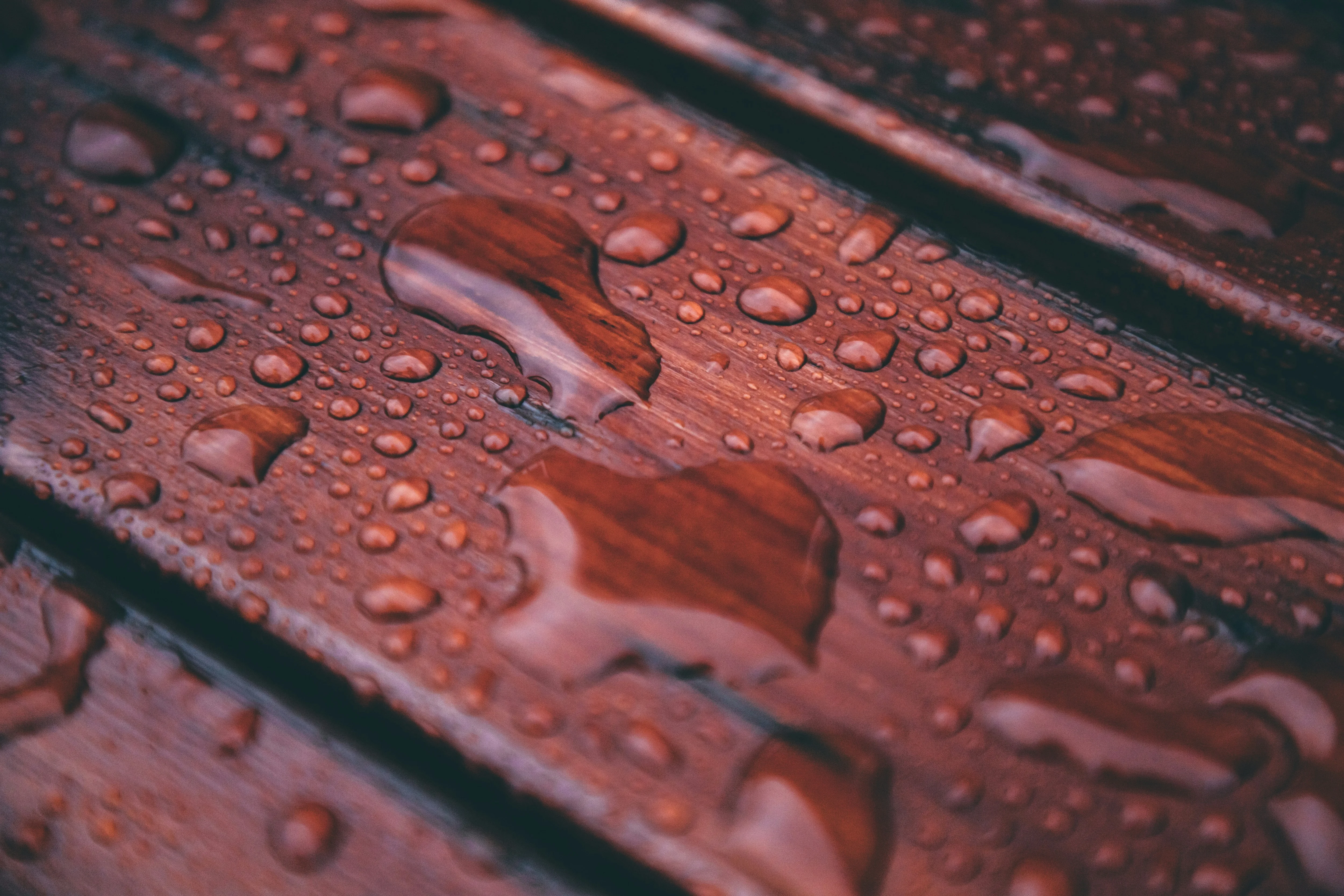
Honestly, the easiest way to settle this is to hold the material. A black locust tongue-and-groove sample shows you the joinery, grain, and finish in your own hands and your own light. And if you're weighing whether to salvage an old floor or start over, our guide to restoring a Victorian porch floor can walk you through it.
Hard-surface outdoor flooring is the default for uncovered patios, pool surrounds, and anywhere drainage happens by slope rather than through the floor.
Porcelain and ceramic tile: Low-porosity porcelain barely absorbs water, and that's what lets it survive freeze-thaw climates that wreck softer tile and unsealed stone. Look for a water absorption figure below 0.5% for cold-climate work, and check the slip rating separately from the frost rating. They're not the same spec, and plenty of people assume they are.
Poured concrete: The cheapest durable outdoor flooring you can buy and the most flexible in finish. Stamping, acid staining, and exposed-aggregate treatments turn a plain slab into something intentional. Its weakness is texture: a smooth troweled finish is genuinely dangerous once it's wet or algae takes hold, so exterior slabs need a broom finish, a shot-blast, or a topical treatment.
Concrete and stone pavers: Handle driveways, paths, and formal patios well, and can be fixed easily — you can lift and reset individual units instead of demolishing everything. Budget for joint sand, weed control, and annual sealing if you want the color to stay put.
Permeable pavers: Instead of shedding water to a slope, they let it pass through the surface into a stone reservoir below. That matters on projects with stormwater requirements, which is why you see permeable systems far more in municipal and campus work than in backyards. Our own ProFlow Pavers™ apply the same idea in wood rather than concrete.
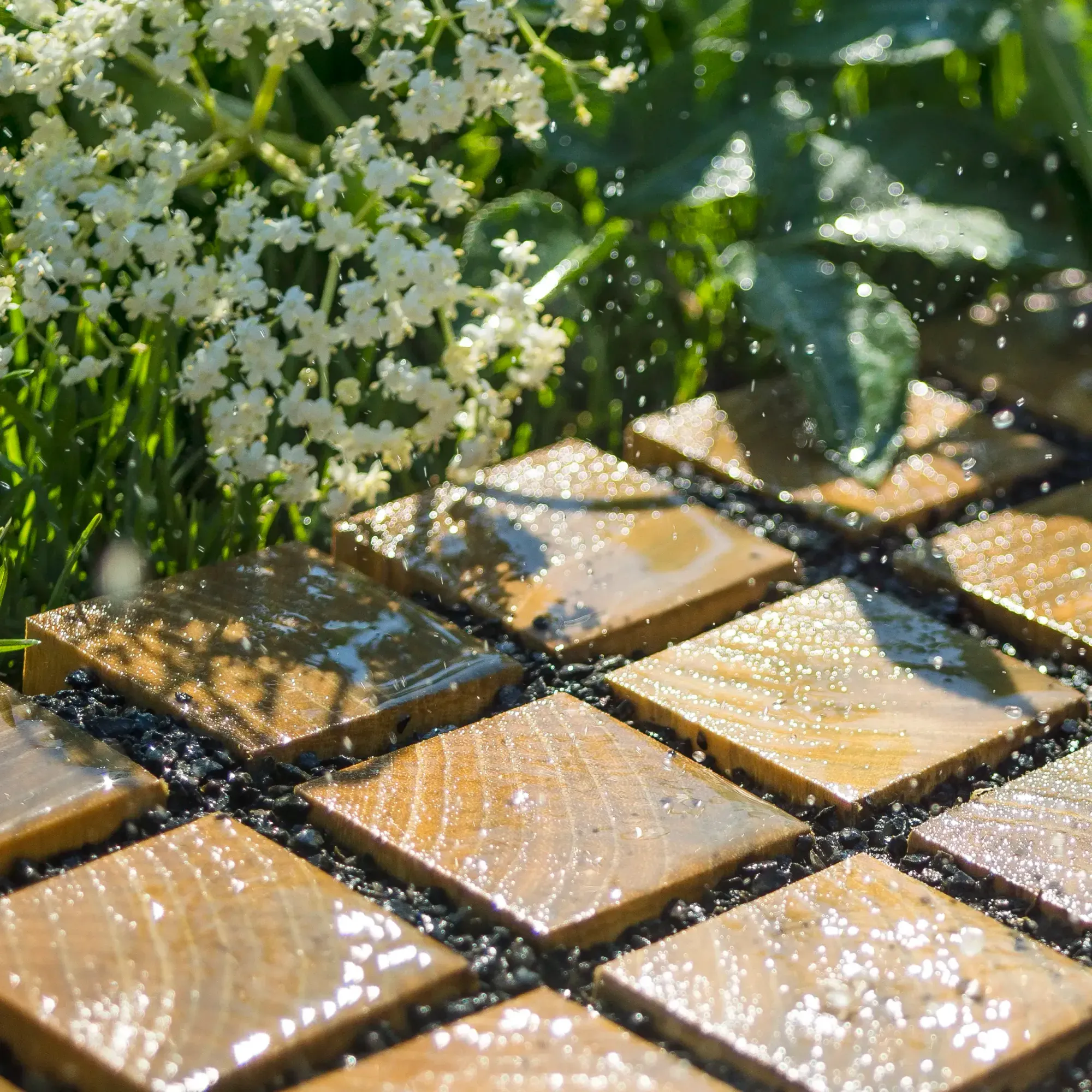
This is the one outdoor flooring category where the species matters more than the manufacturer.
Pressure-treated softwood: cheap, available everywhere, good for 10 to 15 years outdoors. It works because chemicals were forced into it, which is a fair trade on plenty of projects — it just means the protection is finite. Older treated lumber used chromated copper arsenate, and while residential CCA got phased out in the mid-2000s, it's worth knowing what's under your feet on an older structure.
Cedar and redwood: Both are naturally decay-resistant and easy to work with, but soft enough that a busy porch shows wear. Figure 15 to 25 years, plus re-oiling every year or two if you care how it looks.
Naturally durable hardwoods: Ipe, teak, and black locust all resist decay without any treatment. Ipe and teak are tropical imports, which brings supply chain, lead time, and price swings that have nothing to do with the wood itself. Black locust, however, grows across the eastern United States and is one of very few temperate hardwoods in the same durability class, which is why it keeps showing up on boardwalks and public installations where replacement cost drives the decision.
As a lumber supplier in Pennsylvania, we handle sourcing, sawmilling, custom milling, and finished manufacturing in-house so we can match a profile to your drawing instead of asking you to design around whatever's in stock. Our black locust has a documented service life beyond 50 years outdoors and carries a Class A fire rating, with no chemical treatment involved. It's been specified on everything from private residences to the Meta and NVIDIA campuses. And if you aren't sure whether your site calls for tongue-and-groove, gapped boards, or something else, just ask us — we'll tell you straight when it’s the wrong call.
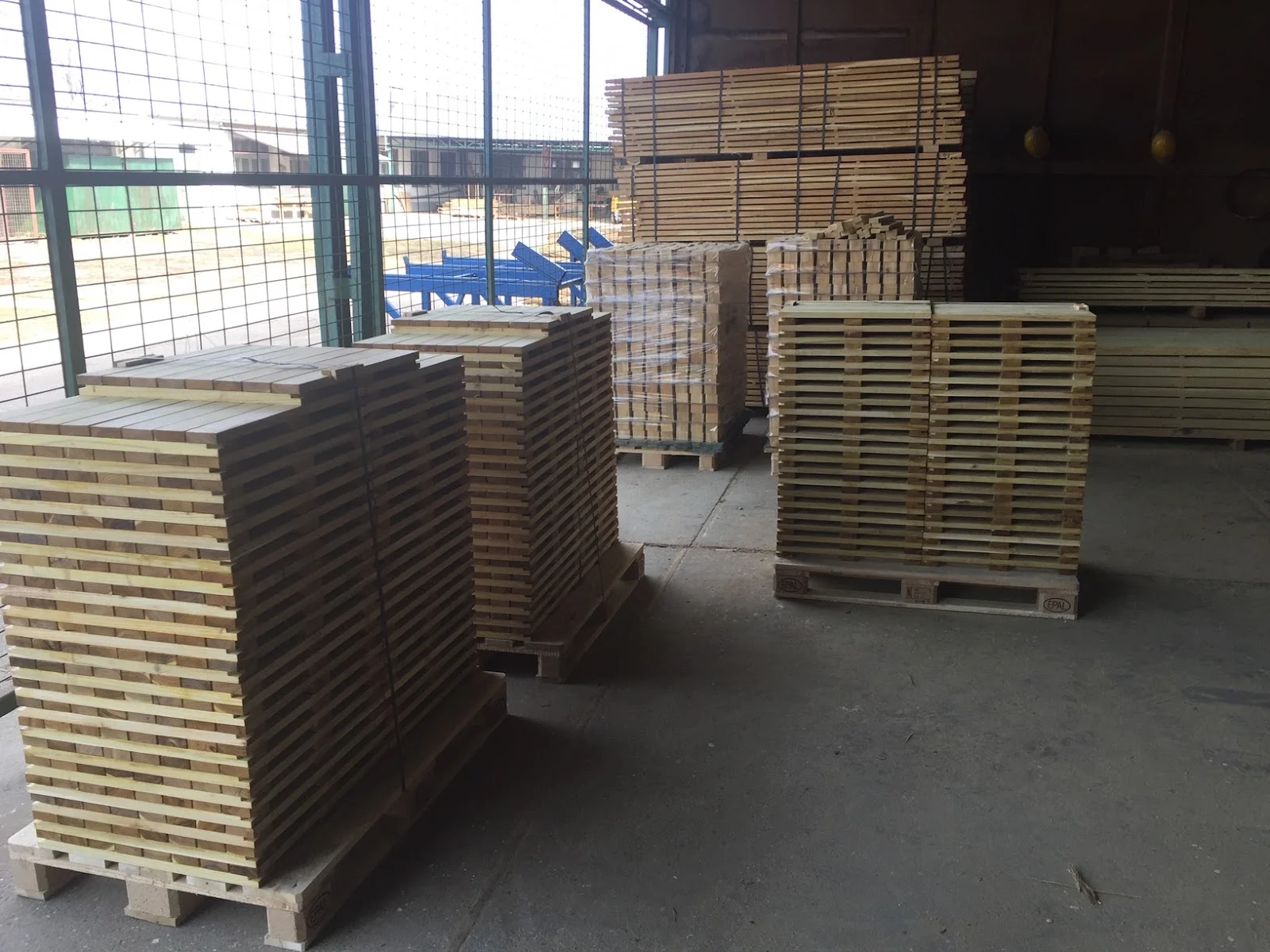
We'll also be honest about the caveats. Because black locust grows in short, irregular lengths, you can design around random lengths instead of ordering 16-footers. And it weathers to a silvery gray outdoors unless you oil it. That color change is cosmetic, not structural, and a lot of architects choose it on purpose.
Composite decking: wood fiber bound in recycled plastic. Capped composite resists fading, staining, and moisture with basically no sealing, and gives you 20 to 30 years. Uncapped, it can drink water at the cut ends. Composite is a strong pick for exposed decks and a mediocre one for tongue-and-groove porch floors, since most systems aren't milled for a locked joint. If you'd like the categories side by side on performance rather than price, we have a comparison of decking products that stacks the options against durability, maintenance, and origin.
These four outdoor flooring types exist to solve problems the hard surfaces can't.
Rubber tile and pavers: give you the best combination of traction and impact absorption in the category, which is why they're standard on playgrounds, pool decks, and sport surfaces. Rubber also keeps its grip when wet, where most smooth surfaces lose theirs. The limits are appearance and a 10 to 15 year replacement cycle.
Outdoor carpet tile: comfortable underfoot and drains through built-in channels. It belongs on covered patios and screened porches, not out in the open.
Artificial turf: solves lawn maintenance rather than flooring, but it competes for the same budget. Plan on brushing, infill top-ups, and antimicrobial treatment in pet areas.
Interlocking PVC and composite deck tiles: snap together over any flat surface with no adhesive or mortar. Raised pedestal feet create a quarter-inch to three-quarter-inch drainage gap underneath, which makes them the practical default for rooftop terraces and existing slabs you can't re-grade. They're removable too, which matters when a roof needs service.
Slip resistance is the most misquoted specification in outdoor flooring, so it's worth getting precise.
The current test method is ANSI A326.3, which measures dynamic coefficient of friction (DCOF). It replaced older static-friction testing because static measurements didn't reflect how a foot actually strikes a floor. According to the standards set by the Tile Council of North America, the 0.42 minimum DCOF applies to level interior floors expected to be walked on when wet with water. The 2022 revision added separate product use categories, and exterior wet applications carry a higher recommended minimum than that familiar 0.42 figure. So if a supplier quotes you 0.42 for an outdoor surface, they're citing the indoor number. Ask for the exterior category.
If you're specifying tile, the DCOF requirement also flows through ANSI A137.1, the ceramic tile product standard, which is why you see that value printed on tile spec sheets and almost nowhere else.
Ramp ratings are a parallel European system. R9 through R13 come from a shod ramp test, with R11 or higher commonly specified for wet exterior areas, while barefoot areas like pool surrounds use a separate A/B/C classification. A tile can carry a strong R rating and still be wrong for a pool deck, so check which test was run.
On accessibility, the standards say less than most articles claim. The U.S. Access Board's guide to floor and ground surfaces says accessible surfaces have to be stable, firm, and slip resistant — but the ADA Standards don't specify a minimum coefficient of friction, because there's no consensus method for rating slip resistance across every surface. That same guidance notes hardened materials including wood are firm and stable enough for accessible routes, while loose material like gravel generally isn't unless it's stabilized. The practical takeaway: you can't compliance-check a floor by reading one number off a data sheet.

Load capacity is the other safety spec. Most residential interlocking deck tiles are rated for 250 to 500 pounds per square foot, and sport court tiles carry separate ratings for lateral movement. On any rooftop or elevated install, confirm the structure's capacity before you choose a surface, not after. If you're working on a boardwalk, rooftop, or public installation and want a second set of eyes, send us the drawings — we quote custom manufacturing plus freight to the job site, and we'd rather flag a problem at the drawing stage than after the material ships.
Standing water causes more premature outdoor flooring failure than anything else, and it's almost entirely a planning problem.
Start with slope. Impermeable surfaces — porcelain, standard concrete, sealed stone — drain only by pitch, and the working minimum is 1/8 inch per foot, always directed away from the structure. Permeable systems and gapped deck boards drain vertically instead, which is why they tolerate flat conditions that would ruin a tile patio.
Substrate requirements change by material:
For tongue-and-groove porch flooring, ventilation below the floor isn't optional. The floor can't dry from above, so it has to dry from below. Skirting a porch tight to the ground is the most common way a perfectly good floor gets ruined.
Freeze-thaw adds another constraint. Porous materials absorb water, water expands when it freezes, and the material cracks from the inside out. In cold climates, favor low-absorption porcelain and rubber, skip unsealed concrete and high-porosity stone, and give dense hardwoods room to move seasonally.
Installation is the part of an outdoor flooring budget people underestimate, and maintenance is the part they forget completely.
Genuinely DIY-friendly: Interlocking deck tiles, rubber pavers, and outdoor carpet tile. Snap-together systems cover a 200-square-foot patio in an afternoon with no specialty tools.
Moderate DIY: Composite and wood deck boards. You'll need a circular saw, a drill, correct fastener spacing, and a real grasp of joist layout. Figure 50 to 80 square feet an hour for an experienced installer.
Tongue-and-groove: Installs like interior flooring, not like decking. Boards get driven together, blind-nailed or screwed through the tongue, and run perpendicular to the joists. Hardwood should acclimate on site for a few days first, and end grain should be sealed. Get the first course wrong and the error compounds across the whole floor, which is why most people hire this one out.
Professional territory: Porcelain tile, poured concrete, and large-format stone. Mortar work, slope, and leveling are all expensive to fix after the fact.
Here's ten-year maintenance, materials and supplies only:
The pattern's consistent: materials that need a coating to survive cost the most to keep, and materials durable on their own cost the least. For how that plays out over decades, see our breakdown of how long a black locust deck lasts.
No. Interior flooring is milled to a moisture content suited to heated indoor air, and it swells and cups once it meets outdoor humidity. The finishes and any adhesives used on it usually aren't rated for exterior exposure, either. Species is the bigger problem: interior favorites like oak, maple, and pine have no meaningful natural decay resistance. Even on a fully covered porch, outdoor flooring should be milled for exterior service in a species that resists decay on its own.
For kiln-dried lumber, 1/8 to 1/4 inch is standard. Boards installed green or wet go down tight, because they'll shrink as they dry and open their own gaps. Too tight and debris packs into the joint and holds moisture against the wood. Too wide and small items drop through, heels catch, and the floor reads unfinished. Your fastener system may also dictate spacing, so check it before you start cutting.
Plan on 10 percent over your square footage for a straight run. Go to 15 or 20 percent for diagonal layouts, patterned floors, or random-length material where you're cutting to fit as you go. Ordering short is the more expensive mistake: a second run milled weeks later may not match the first on color or grain, and you'll see the seam.
Sixteen inches on center is the common spec for 3/4-inch flooring, tightening to 12 inches on center for diagonal layouts, which span farther between bearing points. Joists also need to be level and checked for crown before anything goes down, since a high joist telegraphs through a locked floor and there's no fixing it afterward. Always confirm spacing against the manufacturer's installation guide, because going wider than they specify can void a warranty.
It depends on the material. Mortar-set tile and poured concrete have temperature minimums, generally above 40°F and not falling, and thinset cures unpredictably below that. Snap-together outdoor flooring installs in any weather. Wood is the interesting case: install it in January and the boards are at their driest, so they'll swell come summer, while a July install shrinks in winter. Season affects your spacing, not whether you can do the job.
Usually not for a ground-level patio or for replacing the surface on an existing structure. You typically do for an elevated deck, for any change to the framing or footings, and for anything newly attached to the house. Rooftop work almost always requires review, and often a structural sign-off. Requirements are local, so one call to your building department before you order is worth the ten minutes.

Get two things right and the rest tends to fall into place: match the profile to how much weather the space actually sees, and match the species to how much moisture it'll sit in. Do that, and your floor stops being something you think about.
If a covered porch, pavilion, or screened room is in your plans, Black Locust Lumber will help you get it right. Contact us with your square footage and we'll put together a quote.
Continue Reading
The Domestic Teak Alternative for Decking: Black Locust

Wood Siding: Types, Cost, Lifespan, and What Actually Lasts

The Best Sustainable Alternatives to Traditional Wood Decking, Compared by Cost and Lifespan
%20m%C3%A1solat.webp)
8 Best Rot-Resistant Wood Species for Outdoor Projects, Ranked