Hardwood decking compared: ipe, cumaru, garapa and black locust by hardness, rot resistance, cost per foot and lifespan.
Hardwood decking is decking milled from dense, slow-growing broadleaf trees, and that density is the entire reason it lasts. There's no chemical treatment involved and zero plastic. The board is simply hard enough to shrug off rain, sun, insects, and foot traffic on its own. That's a real departure from what most American decks are built out of, and it's why you'll find hardwood decking on boardwalks, rooftop terraces, and public trails where a replacement job would be a nightmare.
We're Black Locust Lumber, a fully integrated sawmill in central Pennsylvania. For over 25 years, we've worked with one native species, black locust, turning it from fence-post material into an architectural hardwood. It's installed at Meta's Menlo Park headquarters, at Phipps Conservatory in Pittsburgh, and at the High Meadow Dwellings at Fallingwater, among others.
Worth clearing up first, because it gets muddled constantly. Hardwood and softwood are two different families of tree.
Softwoods are the evergreens: pine, spruce, fir, cedar. Hardwoods are the broadleaf trees that drop their leaves each fall: oak, maple, walnut, black locust.
The difference that matters for a deck is growth rate. Slow-growing trees lay down denser, heavier wood, and dense wood takes a lot longer to wear out. Furniture, hardwood floors, and premium decking all come from that side of the family.
Almost every cheap deck in America is softwood: pressure-treated pine. It's fast-growing and low-density, and it can't survive outdoors on its own. So chemicals get forced into it to buy it a few extra years. Those preservatives are pesticides, and the EPA has to register each one before it can go into residential lumber, including alkaline copper quaternary and copper azole.
That's the whole difference in a sentence: softwood decking lasts because of what's been added to it, while hardwood decking lasts because of what it already is.
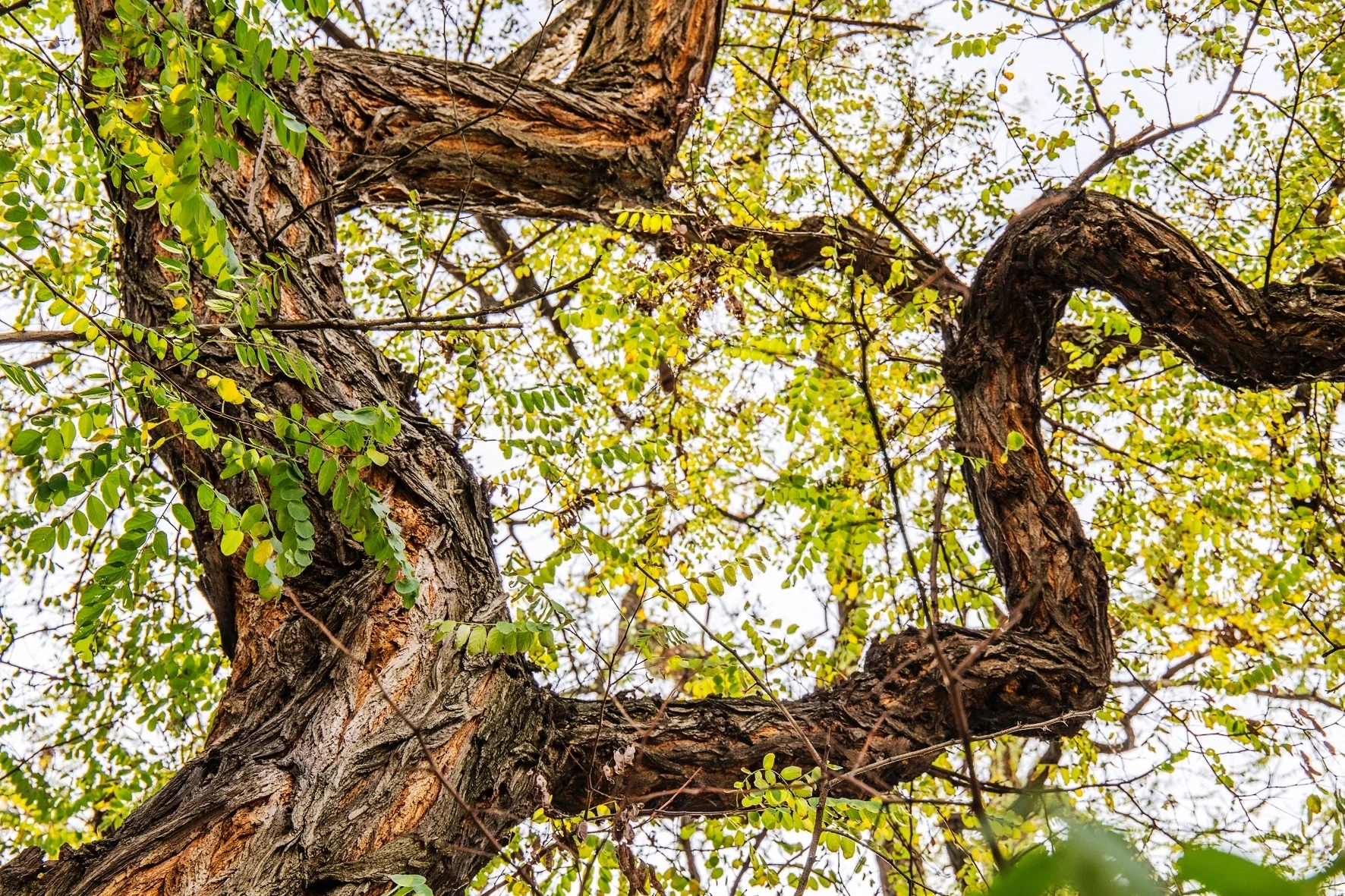
Black locust sits right at the top end of the hardness scale for a North American species, with a Janka rating around 1,700 lbf. It's dramatically denser and harder than cedar, pine, or white oak, which are the domestic woods most buyers are actually comparing against. It's also naturally rot-resistant, and almost nothing else in that group is. For hardwood decking that has to survive ground-level moisture, that matters more than hardness does.
%20m%C3%A1solat.webp)
That combination is the unusual part. Density alone doesn't make a great deck, and rot resistance alone doesn't either. Black locust has both, from a tree grown here rather than shipped out of a rainforest.
The research backs it up.
The USDA Forest Service Wood Handbook calls black locust very heavy, very hard, very resistant to shock, and very strong and stiff, with heartwood that has high decay resistance. Purdue University wood products specialist Daniel L. Cassens puts its density at 48.2 pounds per cubic foot, on par with most oaks. He also reports installing locust posts himself and finding only one failure after 25 years in the ground.
Worth knowing: black locust's original native range started in Pennsylvania. We mill it where it grew up, and back every board with a 50-year limited warranty.
Tropical species are the usual benchmark for hardwood decking, and they've earned it. Ipe and Cumaru are harder than anything grown domestically. If raw Janka numbers are all that matter to you, they win. But hardness isn't the only spec on the sheet.
Garapa and Tigerwood are an interesting comparison. They're barely harder than black locust and less rot-resistant, yet they still travel thousands of miles to reach a job site, with longer lead times and patchier certification along the way. Ipe is the closer call, since it beats black locust on hardness while matching it on rot resistance. If that's the decision you're actually making, we've compared the two head-to-head.

Composite belongs in the conversation, too, though it solves a different problem: it's built to need nothing from you, whereas hardwood decking is built to last. It also runs hotter underfoot, can't be sanded and refinished, and can't be reclaimed as lumber at end of life. If you're weighing all four materials, we've set wood, composite, thermally modified, and pressure-treated side by side.
Hardwood decking is a premium material and prices reflect that. Here's the shape of the market before you get to any single supplier's quote.
Ranges are indicative and vary by grade, profile, and region. For our own material, see our current pricing.
The cheapest board is rarely the cheapest deck. Pressure-treated pine is cheaper per board and more expensive per decade, and on dense material the labor to install it outweighs the material cost anyway. At Black Locust Lumber, we publish our current pricing openly rather than making you request it, so you can run the whole-life math yourself.
Upkeep is where hardwood decking surprises people: the cheapest maintenance plan is no maintenance plan. Left alone, UV light breaks down the surface fibers and the boards weather to a silver-gray patina. The change is cosmetic only, and the wood underneath is unaffected. If you'd rather keep the original honey-brown, a UV-inhibiting penetrating oil once a season will hold it, and you can move between the two whenever you like. The one expense worth planning for? Drainage. Water that can't escape is what actually shortens a deck's life, so keep framing clear of soil and leave air moving underneath.

Dimensions determine joist layout and fastening method, so they matter more than people expect.
Most hardwood decking comes in 5/4x4 and 5/4x6 profiles, either eased-edge for face fastening or grooved for hidden clips. Use 5/4 on joists spaced up to 16 inches on center. Beyond that, or for boardwalks and heavy commercial traffic, 2-inch stock gives you the stiffness and load capacity. We also mill deck tiles in 2x2 and 2x4 for rooftops and small patios, plus custom profiles for spec work.
Black locust is dense enough that it fights back a little during installation. It's hard to nail or screw without drilling a pilot hole first, so allow extra time and use stainless fasteners with carbide-tipped bits. If you'd rather not see any screw heads, we're an authorized DeckWise dealer and can supply hidden clips along with the boards. Brushing a wax sealant onto the cut ends keeps small cracks from opening up there later. All that density pays you back at the framing stage, though, because hardwood decking spans further than pressure-treated softwood and can sit on fewer joists. Our installation guide has the spacing numbers and the gaps to leave between boards.
If you're an architect or a specifier, you're solving for documentation as much as performance. The good news is that hardwood decking documents cleanly when it's a single domestic species. Here's what usually ends up on the submittal.
A domestic, untreated, single-species material is straightforward to document. Our products are Red List Free and used on LEED, Living Building Challenge, and BREEAM projects. Phipps Conservatory in Pittsburgh holds LEED Platinum and Living Building Challenge certification, and the John W. McCormack Federal Post Office and Courthouse in Boston reached LEED Gold with our decking on its fifth-floor green roof.

Wood runs cooler underfoot than concrete, which can help on heat island reduction credits. Accessible roof decks bring their own constraints around load, drainage, and surface temperature, and black locust has been specified on green roofs since well before the credit existed.
Certification is worth verifying on any imported species, since one shipment can be certified and the next one not, depending on the mill and the season. Ask to see FSC chain-of-custody paperwork rather than taking someone's word for it. Domestic material avoids the question altogether. We buy black locust direct from Appalachian landowners, so the supply chain is short enough to walk.
Public walking surfaces usually need slip-resistance data on the submittal, and some occupancies call for a fire classification, too. Ask any supplier for the test report and the standard it was tested against, ours included. A verbal assurance won't survive review.
Our boardwalk at Meta's Menlo Park campus, designed by Frank Gehry's office, has been in service since 2018. The Boston courthouse roof deck, by Goody Clancy with Andropogon Associates, has been in service since 2009. The USDA Forest Service has evaluated naturally durable species, including black locust, in above-ground exposure trials, which helps when you're justifying an untreated material to a client.
Hardwood decking isn't graded the way softwood is, so the supplier matters more than the species does. Four questions worth asking:
Choosing a lumber supplier in Pennsylvania has a practical upside if you're building in the Northeast or Mid-Atlantic: the wood grew up in roughly the climate it's about to live in, and freight is a truck ride instead of an ocean crossing.

Dense, rot-resistant hardwood decking commonly lasts 40 to 50 years or more above ground, often outliving the framing beneath it. We warranty our boards for 50 years, by which point a softwood or composite deck has usually been replaced two or three times.
Black locust, for most projects. You give up raw hardness and gain domestic sourcing, simpler certification, and no rainforest exposure. Garapa and Tigerwood come closest on hardness, but they're less rot-resistant and still ship from South America.
It depends entirely on the species. Tropical hardwoods carry real deforestation exposure unless the chain of custody is documented. Black locust is domestic, needs no chemical treatment, and reaches harvestable size in a few decades.
Yes, and it's one of the better uses for it. Deck tiles and pedestal-mounted pavers sit above the waterproofing membrane without penetrating it. Confirm structural loading with your engineer first.
Less than you'd expect. Dense hardwoods hold their surface texture rather than fuzzing up, and the finish matters more than the wood: a film-forming sealer is usually what creates a slick surface. For public projects, ask any supplier for slip-resistance data to attach to the submittal.
Specifying a deck, a boardwalk, or a rooftop terrace? Talk to the people who cut the boards. Every hardwood decking profile we sell is milled at our own Black Locust sawmill in central Pennsylvania, so we can tell you exactly what grade you're getting and exactly when it ships. We'll send a physical sample first, too, so you can feel the density in your hand before you spend a dollar.
Take a look at our black locust decking options, then tell us about your project, and we'll come back with a quote and a lead time you can actually build a schedule around.
Continue Reading

The Best Wood for Decks: A Guide to Outdoor Decking

Commercial Decking: Boardwalks, Public Spaces, Rooftops
Composite Decking's Heat Problem. And Why Black Locust Doesn't Have It
Black Locust vs Cedar Decking: Why the “Natural Choice” Is No Longer Cedar